
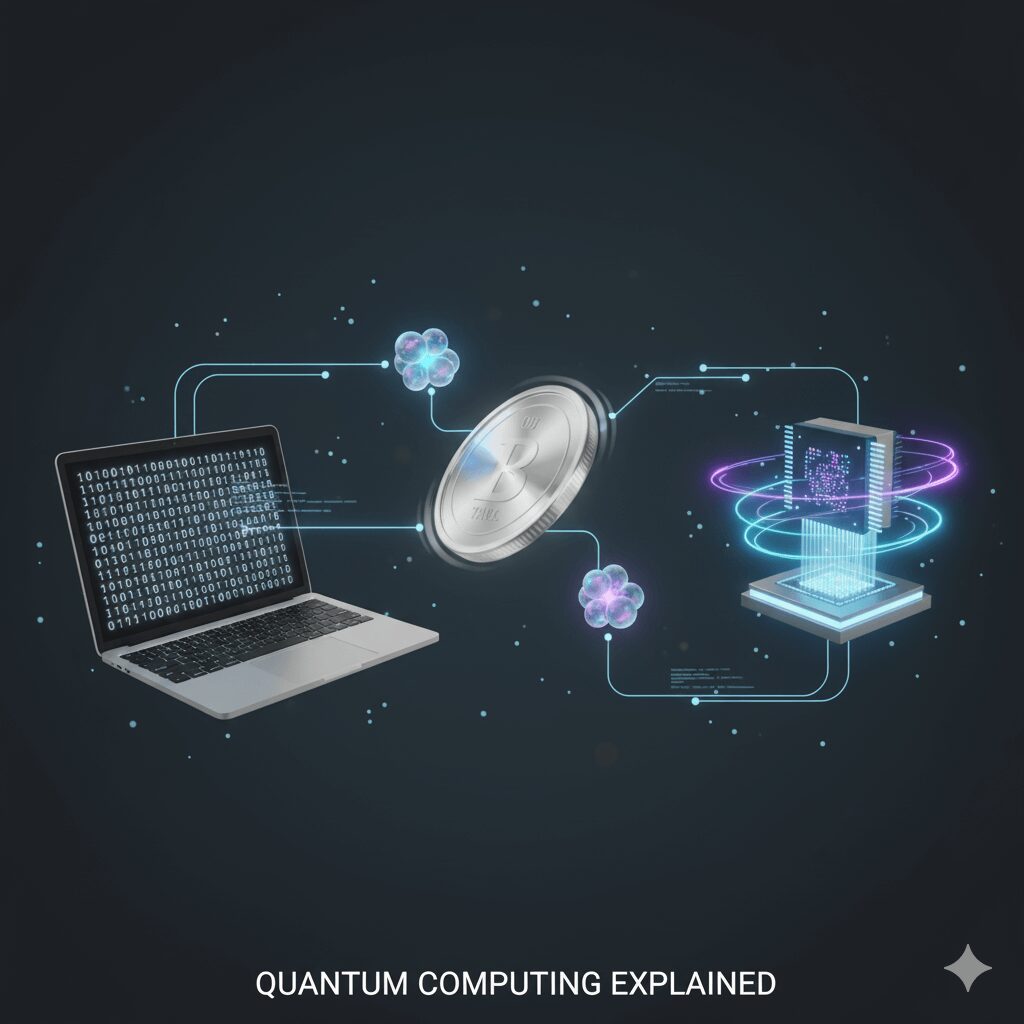
Introduction: Why Quantum Computing Matters
Quantum computing is one of the most talked-about technologies of our time — and for good reason. It promises to solve problems that would take today’s most powerful supercomputers millions of years to crack. Yet for most people, the term still sounds like science fiction. This beginner-friendly guide breaks down quantum computing in plain language, explaining what it is, how it works, where it’s being used today, and why governments and tech giants are investing billions of dollars into its development. No physics degree required.
What Is Quantum Computing?
To understand quantum computing, you first need to understand how a classical computer works. Every traditional computer — from your laptop to the world’s fastest supercomputer — processes information using bits. A bit is the smallest unit of data and can only exist in one of two states: 0 or 1.
A quantum computer works differently. Instead of bits, it uses qubits (quantum bits). Thanks to the laws of quantum mechanics, a qubit can exist as 0, 1, or both at the same time. This property — called superposition — allows quantum computers to process a vast number of possibilities simultaneously, giving them extraordinary computational power for certain types of problems.
How Qubits Work: Core Quantum Concepts Explained
Two fundamental principles of quantum mechanics make qubits so powerful: superposition and entanglement. Understanding these concepts is the key to understanding quantum computing.
Superposition
Superposition means a qubit can be in multiple states at the same time — until it is measured. Think of a regular light switch: it is either on or off. Now imagine a spinning coin: while it spins, it is effectively both heads and tails simultaneously. The moment it lands, it becomes one or the other. A qubit behaves similarly. This allows a quantum computer to explore many possible solutions to a problem at the same time, rather than testing them one by one.
Entanglement
Entanglement is another strange but powerful quantum phenomenon. When two qubits become entangled, the state of one instantly influences the state of the other — no matter how far apart they are. Albert Einstein famously called this “spooky action at a distance.” In computing, entanglement allows qubits to work in perfect coordination, enabling quantum computers to perform highly complex, interconnected calculations with remarkable efficiency.
Quantum Interference
A third important concept is quantum interference. Quantum algorithms are designed to amplify computational paths that lead to correct answers and cancel out paths that lead to wrong ones. This dramatically increases the probability of arriving at the right solution, making quantum algorithms far more efficient for specific problem types.
Why Quantum Computing Is Important
Classical computers are incredibly powerful for everyday tasks — browsing the internet, running spreadsheets, streaming video. But they struggle with certain categories of problems that require evaluating an enormous number of variables simultaneously. Quantum computers are specifically designed to handle these challenges, including:
- Simulating complex molecular and chemical interactions
- Optimizing large-scale logistics and supply chains
- Breaking and building advanced encryption systems
- Accelerating machine learning and AI model training
- Modeling climate systems and predicting weather patterns
It is important to note that quantum computers are not a replacement for classical computers. They are specialized tools designed to complement existing technology by tackling specific, highly complex problems.
Real-World Applications of Quantum Computing
Medicine and Drug Discovery
Drug development is one of the most promising fields for quantum computing. Designing a new medicine requires scientists to simulate how molecules interact at the atomic level — a task that overwhelms classical computers when the molecules become complex. Quantum computers can model these interactions with far greater accuracy, potentially accelerating the discovery of treatments for cancer, Alzheimer’s disease, and rare genetic conditions. What might take decades in a traditional lab could one day take years — or even months.
Climate Science and Weather Prediction
Accurate climate modeling requires processing billions of data points across atmosphere, ocean, land, and ice systems simultaneously. Quantum computers can analyze this data at speeds classical systems cannot match, leading to more precise weather forecasts, better disaster preparedness, and more effective climate change mitigation strategies. Improved storm and flood predictions alone could save thousands of lives annually.
Cybersecurity and Encryption
Quantum computing poses both a threat and an opportunity for cybersecurity. On one hand, powerful quantum computers could eventually break the encryption methods that currently protect banking systems, government communications, and personal data. On the other hand, quantum mechanics also enables quantum cryptography — an entirely new form of encryption that is theoretically impossible to hack. Organizations around the world are already working on post-quantum encryption standards to prepare for this shift.
Finance and Risk Analysis
Financial institutions use quantum computing to run complex risk analyses, detect fraudulent transactions, optimize investment portfolios, and simulate market scenarios. Tasks that currently take hours to compute could be completed in seconds, giving banks and trading firms a significant competitive advantage and helping reduce systemic financial risk.
Artificial Intelligence
Quantum computing has the potential to supercharge AI development. Training large AI models currently requires enormous amounts of computing power and energy. Quantum algorithms could reduce training times dramatically, improve pattern recognition, and enable AI systems that are significantly smarter and more efficient. This will accelerate advances in areas like natural language processing, medical diagnostics, autonomous vehicles, and robotics.
How Quantum Computers Are Built
Quantum computers are extraordinarily delicate machines. Qubits are highly sensitive to their environment — even the slightest vibration, heat, or electromagnetic interference can cause them to lose their quantum state, a problem known as decoherence. To function correctly, quantum computers require:
- Temperatures close to absolute zero (around -273°C), colder than outer space
- Complete isolation from vibration and electrical noise
- Precision control using lasers and microwave pulses
- Specialized superconducting materials
This is why quantum computers often look like enormous golden chandeliers suspended inside cylindrical freezing chambers — an iconic image that has come to represent the frontier of computing technology.
Current Limitations of Quantum Computing
Despite their enormous potential, quantum computers are still in the early stages of development. Key challenges include:
- Qubit instability: Qubits are fragile and prone to errors caused by decoherence
- Error rates: Current quantum computers make significantly more errors than classical computers
- Limited qubit counts: Today’s most advanced systems have hundreds to a few thousand qubits; practical applications may require millions
- High cost: Building and maintaining quantum hardware is extremely expensive
- Programming complexity: Quantum algorithms require specialized knowledge and are difficult to develop
Researchers are making rapid progress on all of these fronts, and the pace of improvement is accelerating every year.
Who Is Leading the Quantum Computing Race?
Some of the world’s most powerful technology companies and research institutions are competing to build the most capable quantum computers:
- Google Quantum AI — achieved a milestone called quantum supremacy in 2019
- IBM Quantum — offers cloud-based quantum computing access through IBM Quantum Network
- Microsoft Azure Quantum — pursuing a unique topological qubit approach
- Intel — developing silicon-based quantum processors
- D-Wave — specializes in quantum annealing for optimization problems
- Amazon Braket — provides cloud access to multiple quantum hardware platforms
Leading universities including MIT, Stanford, Caltech, and Oxford are also conducting groundbreaking quantum research, ensuring a strong pipeline of scientific talent and discovery.
The Future of Quantum Computing
Over the next decade, quantum computing is expected to move from research labs into real-world commercial applications. Experts predict that quantum breakthroughs will help humanity:
- Develop cures for diseases that are currently untreatable
- Build ultra-secure global communication networks
- Design new materials for clean energy and batteries
- Dramatically improve the efficiency of AI systems
- Advance space exploration and astrophysics research
- Optimize global supply chains, transportation, and agriculture
Many technology historians believe quantum computing will be as transformative as the invention of the internet — fundamentally reshaping science, industry, and daily life.
Conclusion
Quantum computing is no longer just a theoretical concept — it is a rapidly advancing technology with the power to reshape the world. By harnessing the strange rules of quantum mechanics, quantum computers can solve problems that are completely beyond the reach of classical machines. From accelerating drug discovery and securing our digital lives to fighting climate change and advancing artificial intelligence, the applications are both vast and genuinely exciting. While the technology is still maturing, the pace of progress is remarkable. Understanding the basics of quantum computing today puts you ahead of the curve for the technological revolution that is already underway.
Frequently Asked Questions About Quantum Computing
What is quantum computing in simple terms?
Quantum computing is a type of computing that uses the principles of quantum mechanics — the physics governing subatomic particles — to process information in fundamentally different ways than a classical computer. Instead of using bits that are either 0 or 1, quantum computers use qubits that can be 0, 1, or both simultaneously. This allows them to solve certain complex problems exponentially faster than traditional computers.
Is quantum computing the same as supercomputing?
No, quantum computing and supercomputing are not the same thing. A supercomputer is simply a very fast classical computer — it still uses traditional bits and standard computing architecture. A quantum computer uses entirely different physics and hardware. For specific types of problems, a quantum computer with relatively few qubits could outperform even the most powerful supercomputer in existence.
Will quantum computers replace regular computers?
No. Quantum computers are not designed to replace the laptops, smartphones, and servers we use every day. Classical computers are perfectly suited for most everyday tasks like email, web browsing, video streaming, and word processing. Quantum computers are specialized tools best suited for specific, highly complex computational challenges in fields like chemistry, cryptography, finance, and AI research. The two technologies will work alongside each other.
How soon will quantum computers be widely available?
Limited access to quantum computers is already available today through cloud platforms like IBM Quantum and Amazon Braket. However, large-scale, fault-tolerant quantum computers capable of solving major real-world problems are likely still a decade or more away. Progress is accelerating rapidly, and many experts believe practical quantum advantage across multiple industries will be a reality within the 2030s.
Is my data at risk from quantum computers?
Not immediately, but it is a growing concern. Current quantum computers are not yet powerful enough to break modern encryption. However, cybersecurity experts warn of a concept called “harvest now, decrypt later” — where adversaries collect encrypted data today with the intention of decrypting it once quantum computers become sufficiently powerful. This is why organizations worldwide are already developing and adopting post-quantum cryptography standards to future-proof sensitive data.
